Break Free B2B Series: Adi Bachar-Reske on Taking the Lead in the Evolution of B2B Content Marketing
Get link
Facebook
X
Pinterest
Email
Other Apps
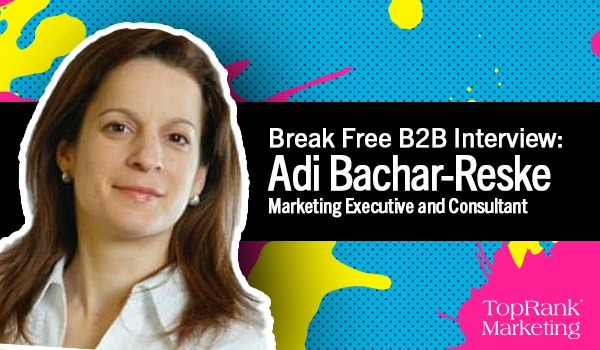
Marketing leaders are at the forefront of a seismic transformation that continues to play out as we enter a new decade. Organizational dynamics are realigning. Power balances are shifting. Trust – both internal and external – is emerging as the most essential crux in business success. For people likeAdi Bachar-Reske, it's an exhilarating time to be leading the charge.Her history in marketing dates back multiple decades, so she’s been helping shape this evolution. “Twenty years ago, everybody’s in a suit. I was the only woman in the room, always,” she says. “It has changed a lot.”Today, she finds that she no longer tends to be the only woman in the room (though the balance is still a ways from where it needs to be), and that’s far from the only change she’s observed in her marketing leadership positions — most recently at Provenir, where she served as Vice President of Marketing before moving into a solo consulting role late last year. Much of her experience, including at Provenir, has come in the financial technology (FinTech) space, so during my interview with her for the Break Free B2B series, we zeroed in on some key topics tied to the vertical: proving the revenue impact of marketing, staying on top of content consumption trends, and building trust with customers when sensitive data is in play.
Break Free B2B Interview with Adi Bachar-Reske
If you’re interested in checking out a particular portion of the discussion, you can find a quick general outline below, as well as a few excerpts that stood out to us.
1:00— Introduction to Adi
2:00— Provenir’s marketing philosophies
4:00— How are content consumption trends changing?
10:30— Building trust in the financial industry
13:15— How technology helps with personalization and trust
16:00— Building trust in marketing internally
18:45—Which types of content help sales most?
22:00—How can B2B marketers break free?
24:00—How to balance taking risks with playing it safe
Nick:What are you seeing from your end in terms of shifting content consumption trends and shortening attention spans?Adi:I find that myself, I don't read books anymore, my eyes get really tired and I just don't have the time to sit down and actually read, but what I do do, I got addicted to Audible right? So I walk through a long airport, or I sit down and wait for my daughter to finish her guitar lesson, and I'll just put it in my ears. I read at least two books a month that way and I love it because of the way Audible, they've changed too right? So you've got the authors now reading the story. It's a bit like a TED Talk that lasts for a few hours, which is brilliant. And the same for blogs. Blogs were the big thing a few years ago, but again, we don't have time to read, so we did this test here. We took some of the blogs and we kind of condensed them, shrank them up into a one-minute video. It was the same content, but obviously a lot less. And we captured the essence of it, and the engagement was just phenomenal. I think we're all very curious people in the same way we were 10 or 20 years ago, we just consume information differently. [bctt tweet="I think we're all very curious people in the same way we were 10 or 20 years ago, we just consume information differently. @AdiBacharReske #ContentConsumption #BreakFreeB2B" username="toprank"] Nick:Being in the finance industry, I have to imagine that trust, data security, privacy, those are big issues. What are you seeing from your perspective as far as the condition of trust between customers and brandsAdi:Years ago the saying was, nobody's going to lose their job for choosing IBM. If you were a big brand, you were safe, and the financial institution had an immediate trust in you. Easy peasy. But if you were a small brand then it was difficult to get in. They didn't trust you. You were just small, maybe you'll disappear tomorrow. It's funny, things have changed. I speak to my customers, large institutions and small institutions, all the time and I ask them: why did you choose us? We're not a big player, we're not an IBM. In the past year or so, the answer I get is kind of surprising. They say, we chose you because you are small. We chose you because we wanted to work with somebody who's nimble, who can work with us, who can focus on us, because all these large businesses, you know they have other things to worry about. They may not focus on us, they may not sit down, listen to what we need, build something special for us ... So these days, the way you build the trust is showing how nimble and flexible you can be. Both in your development and your product, but also it has to be reflected in your marketing and your digital presence. You have to look accessible, you have to look open. [bctt tweet="These days, the way you build trust is showing how nimble and flexible you can be. Both in your development and your product, but also it has to be reflected in your marketing and your digital presence. @AdiBacharReske #BreakFreeB2B" username="toprank"] Nick:As a marketing leader who regularly interfaces with other leadership in the company, what are your strategies for building trust internally, across departments?Adi:Numbers, numbers, numbers. So again, I’ve been around for a long time and marketers used to be the first one — when the quota hasn't been met or something happened like that — the marketers were the first people out the door. Why? Because we couldn't really show any numbers. You know, we spend all that money on an event, or we spend all that money on a beautiful site ... What did it do for us? What did we get back for it? Nothing, nobody knows really. I mean there were anecdotes here and there but we don't really know. So over the years they created all these beautiful technologies that help us measure that, and it's up to us to create the KPIs that ensure the bottom line. So my strategy from day one was to show the bottom line. We spent X, and therefore as a result we had Y inbound leads that turned into whatever converted and whatever closed ... With management, the way I grew my team is, I was able to show the numbers and how they grew, and with that I got more investment, and I was able to show more and more and more.Stay tuned to the TopRank Marketing Blog and subscribe to ourYouTube channelfor more Break Free B2B interviews. Here are a few interviews to whet your appetite:
LinkedIn is launching interactive, Clubhouse-style audio events this month in beta; a video version will come this spring Microsoft's LinkedIn will launch a new live virtual events platform, beginning with audio-only functionality, followed in time by an array of video features for the flexible hosting and management of online events, adding to the platform's creator features, LinkedIn (client) recently announced. TechCrunch Social Media Forecast to Overtake TV in Ad Spend This Year A robust 14.8 percent annual growth rate for social media advertising spending over the 2021 through 2024 period tops online video’s 14 percent and paid search’s 9.8 percent, according to newly-released global ad spending growth rate forecast data. MarketingCharts 2022 Instagram Stories Benchmark Report Instagram Stories are being utilized more than ever by brands on the social media platform, according to recently-released report data of interest to digital marketers from Rival IQ, based on ...
With hybrid and remote work here to stay and digital-first marketing on the rise, how can B2B marketers make the most of these important shifts? Although I’ve written about remote work before, in pieces including “ Remote Communication Opportunities For B2B Marketers ,” “ Day 4,777: Remote Work Tips From 13+ Years As A Distance Marketer ,” and “ Hybrid & Remote Work Trends That Will Alter The Future Of B2B Marketing ,” the permanent changes to where and how we work have significant implications that will affect B2B marketers forever, so it’s time to reassess. Let’s take a close look at five ways B2B marketers can make the most from remote and hybrid work and digital-first brand interactions, from the perspective of someone who’s been working entirely remotely for 15 years, and from several top voices on the future of work. 1 — Adjust To The Permanent Shift In How We Work As I enter my thirty-eighth year working online, I’ve worked remotely for 5,409 days, and spent close to 40 p...
Is your agency a vendor or a partner? In response to the shifting market and evolving role of the CMO, agency-brand partnerships are shrinking in average duration, less than three years now, compared to over seven in 1984. But strategic, strong partnerships between brands and agencies have become increasingly important as 64% of CMOs expect to feel more pressure to demonstrate tangible short term results in the next 2-3 years. This pressure also signals a big opportunity for CMOs to demonstrate the value of marketing as a strategic function with organizations. The right agency, that can support the brand in a true partnership, can be critical in helping CMOs achieve their goals and win over the rest of the C-suite. That right agency, though, is tough to find — especially in the B2B space where market needs are shifting rapidly and new spaces and topics are constantly being created. How can you find an agency that isn’t just a vendor? How can you trust that you’ve chosen a true...


Comments
Post a Comment