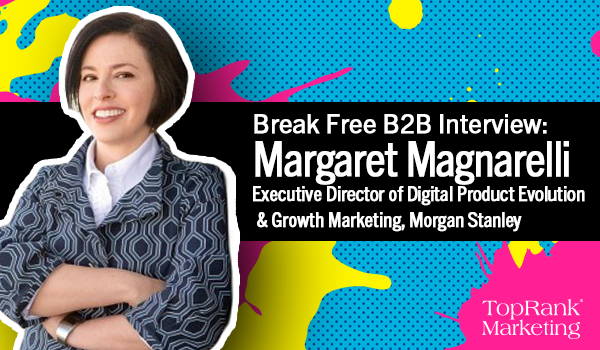
Break Free B2B Series: Margaret Magnarelli on the Psychology of Trust for Better Content Marketing
Get link
Facebook
X
Pinterest
Email
Other Apps
Trust in marketing—how to build itandhow to wield it for good—needs to be top of mind for every modern marketer. Why? Because nearly every decision people make, especially when it comes to purchasing decisions, has an element of trust built in. And content marketers have the opportunity to become trusty guides.“No one knowseverythingabout everything,”Margaret Magnarelli, Executive Director of Digital Product Evolution and Growth Marketing at Morgan Stanley, shared with us in a recent Break Free B2B interview. “So, we have to be able to give our customers as much information as we can… and take them as close to the line of purchase—to theexperienceof purchase—as we can.”According to Margaret, understanding and leveraging the psychology of trust—the intellectual and emotional factors that guide our trust instincts—can be incredibly powerful. But building trust isn’t a solo marketing department endeavor (or ploy).“If you want to be a trustworthy company… it can’t be just a marketing philosophy. It has to be a business philosophy," she said. “People can see through fake attempts to build trust. So, I would caution brands away from being all things to all people.” [bctt tweet="If you want to be a trustworthy company… it can’t be just a marketing philosophy. It has to be a business philosophy. @mmagnarelli #BreakFreeB2B #TrustInMarketing" username="toprank"] From the four “trust factors” to engaging the C-suite around trust to key metrics, listen into Margaret’s full audio interview with TopRank Marketing President Susan Misukanis below.
Break Free B2B Interview with Margaret Magnarelli
If you’re interested in checking out a particular portion of the discussion, you can find a quick general outline below, as well as a few excerpts that stood out to us.
1:10– Why marketers need to car about building trust
2:50– Four factors of trust
5:20– Trust as a corporate value
7:12– Where marketers can make a difference in building trust with consumers
9:40– Maintaining authenticity while tailoring messages to audience “weaknesses”
10:57– Building brand intimacy with consistency
13:20– The bottom-line impact of “trust incidents”
15:16– Engaging the C-suite around trust
19:20– Measuring and monitoring brand trust
20:30– Intertwining trust messaging in current content marketing projects
22:18– Building trust under pressure to drive results
23:15– The state of trust in marketing in 3 to 5 years
24:57– How marketers can break free
Sue:How are we providing prospective customers the information they need to bring them as close to the line of purchase as possible? How does trust factor in?Margaret:... Trust comes out of two different parts of our brain. There's the cognitive part of trust that comes out of logic and proof points and data. And then there's the intuitive part of trust that comes out of our feelings and our intuition or heart. And interestingly enough, some of the research that has been done by marketing academics, has shown that [when there’s a] higher price point for a purchase, the more that process becomes intuitive rather than cognitive. [bctt tweet="Trust comes out of two different parts of our brain. There’s the cognitive part that comes out of logic, proof points, and data. And there’s the intuitive part that comes out of our feelings, intuition, or heart. @mmagnarelli #BreakFreeB2B " username="toprank"] In any case, there are four major themes and factors into the trust analysis that we do. And they arebenevolence, capability, authenticity and honesty. So, benevolence: We want to know… does this person have our best interests at heart? Capability: Can they actually do the things that they say they can do? Authenticity: Are they real and genuine? And honesty: Are they truthful and transparent and what they're doing? And so using these four factors, and making sure that we are telling our stories with that framework in mind can really help us to establish trust with consumers.Sue:Where do you think the gaps are in terms of getting to that trust utopia?Margaret:I think that part of it comes from people's initial perspectives on trust. There's one thing that we can't really overcome as brands and that's people's trust disposition. So, if you look at the psychological research—with Erik Erikson, the developmental psychologist—the first phase of development is earning trust. It's the first task of the ego, he has said. And, and what, what that means is that we learn whether or not to be trusting individuals in those first 18 months of life because as babies if you're crying, are your needs being met? Is someone coming to feed you or put you in bed or hold you? If you are not in a household that has that level of responsiveness and care, you might actually have a very low trust disposition— meaning that you aredisinclinedto trust, versus someone who was in a household that was very responsive to that and they have a high trust responsiveness. Now that is something that our consumers all come to us with... it's their personal history, and we have no ability to change that right. So where we have the ability to change things is in those four factors that that I was talking about—the capability benevolence, authenticity and honesty… The things that we could do more of as content marketers is, I think, the capability aspect… Making sure that we are not just telling people that we do with thing, but like really showing them… So how can we actually in video form or even in text form, like really prove to the people that our products work? And I think that also comes out of using third party validation where we can… It's hard for consumers to just believe a brand when they say they can do a thing. So if you have other people who say you can do a thing and you can do it well, and they can be your advocates, that's really powerful. So that's another area that I think that we really have the ability as brands to continue to leverage… Looking for our customers to help be our advocates, and looking for those outside proof points, and sharing those with our audiences so that they can understand how things work. [bctt tweet="It’s hard for consumers to just believe a brand when they say they can do a thing... That’s where third party validation can be really powerful. @mmagnarelli #BreakFreeB2B" username="toprank"] Sue:You talk about “trust incidents”—Can you share a little bit about that?Margaret:The main reasons that people lose trust with brands or what you would expect. So the primary one is poor product experience, like someone has not achieved the goal that they were looking to achieve with the product, or the product and didn't deliver in some other way, or felt they felt negative after the product experience. The second one is poor customer experience.But then some of the other reasons that people lose trust are again, things that you would probably expect, things like security breaches, leadership scandals, and that sort of thing… When something happens on a mass scale, like a leadership scandal or a security breach, companies really suffer the data shows that they suffer. I think it was an average 5% loss in revenue growth for the year that the trust incident happened; I believe that Accenture did that study.Stay tuned to the TopRank Marketing Blog and subscribe to ourYouTube channelfor more Break Free B2B interviews. Here are a few interviews to whet your appetite:
LinkedIn is launching interactive, Clubhouse-style audio events this month in beta; a video version will come this spring Microsoft's LinkedIn will launch a new live virtual events platform, beginning with audio-only functionality, followed in time by an array of video features for the flexible hosting and management of online events, adding to the platform's creator features, LinkedIn (client) recently announced. TechCrunch Social Media Forecast to Overtake TV in Ad Spend This Year A robust 14.8 percent annual growth rate for social media advertising spending over the 2021 through 2024 period tops online video’s 14 percent and paid search’s 9.8 percent, according to newly-released global ad spending growth rate forecast data. MarketingCharts 2022 Instagram Stories Benchmark Report Instagram Stories are being utilized more than ever by brands on the social media platform, according to recently-released report data of interest to digital marketers from Rival IQ, based on ...
With hybrid and remote work here to stay and digital-first marketing on the rise, how can B2B marketers make the most of these important shifts? Although I’ve written about remote work before, in pieces including “ Remote Communication Opportunities For B2B Marketers ,” “ Day 4,777: Remote Work Tips From 13+ Years As A Distance Marketer ,” and “ Hybrid & Remote Work Trends That Will Alter The Future Of B2B Marketing ,” the permanent changes to where and how we work have significant implications that will affect B2B marketers forever, so it’s time to reassess. Let’s take a close look at five ways B2B marketers can make the most from remote and hybrid work and digital-first brand interactions, from the perspective of someone who’s been working entirely remotely for 15 years, and from several top voices on the future of work. 1 — Adjust To The Permanent Shift In How We Work As I enter my thirty-eighth year working online, I’ve worked remotely for 5,409 days, and spent close to 40 p...
Is your agency a vendor or a partner? In response to the shifting market and evolving role of the CMO, agency-brand partnerships are shrinking in average duration, less than three years now, compared to over seven in 1984. But strategic, strong partnerships between brands and agencies have become increasingly important as 64% of CMOs expect to feel more pressure to demonstrate tangible short term results in the next 2-3 years. This pressure also signals a big opportunity for CMOs to demonstrate the value of marketing as a strategic function with organizations. The right agency, that can support the brand in a true partnership, can be critical in helping CMOs achieve their goals and win over the rest of the C-suite. That right agency, though, is tough to find — especially in the B2B space where market needs are shifting rapidly and new spaces and topics are constantly being created. How can you find an agency that isn’t just a vendor? How can you trust that you’ve chosen a true...


Comments
Post a Comment