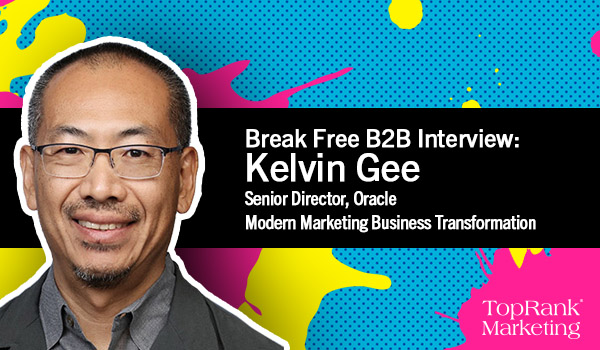
Break Free B2B Series: Kelvin Gee on Winning with Enterprise ABM
Get link
Facebook
X
Pinterest
Email
Other Apps
Everyone in B2B is talking about account-based marketing. And almost everyone is practicing it in some form — around 93% of organizations, according to SiriusDecisions. “Not many are killing it though,” says Kelvin Gee. “That's the problem. They start pilots ... then they re-launch and learn from the mistakes. That's just a natural maturation.” This is a fundamental process in digital marketing, of course: test, assess, optimize. But in the Break Free B2B series, our goal is to help you fast-forward it by learning from the mistakes, successes, and revelations of your innovating peers in the field. And as the Senior Director of Modern Marketing Business Transformation at Oracle*, Kelvin draws from a deep well of experience at one of the powerhouse brands in enterprise technology. Walking the walk is different from talking to talk, but it’s easy to see why companies across the spectrum are seeking to do both. “Companies do need to be more customer-centric, deliver a better customer experience, personalize the content, align with sales, and measure themselves differently,” he observes. “I call account-based a strategic glue that pulls all that stuff together.” In his conversation with TopRank Marketing’s Josh Nite, filmed in Arizona during B2B Marketing Exchange in February, Kelvin shares his perspectives on what it takes to actually make ABM work, and how Oracle empowers its people to thrive within this framework. It comes down to a fairly simple and repeatable model: standardize, evangelize, train, enable. [bctt tweet="“Standardize, Evangelize, Train, Enable,” @kgee’s model for implementing #ABM at scale in large organizations like @oracle. #BreakFreeB2B. — Kelvin Gee" username="toprank"] During an expansive 25-minute interview, Kelvin unpacks the inner workings of enterprise ABM, from getting buy-in to rethinking attribution to developing meaningful metrics and beyond.
Break Free B2B Interview with Kelvin Gee
If you’re interested in checking out a particular portion of the discussion, you can find a quick general outline below, as well as a few excerpts that stood out to us.
1:00 - Kelvin's definition of modern marketing
1:45 - Scaling account-based marketing
2:15 - Strategic adaptations in the evolution of ABM
3:30 - How does an organization adopt a new marketing philosophy?
5:00 - Who should lead the charge for transformation?
7:15 - Metrics Oracle looks at to measure ABM success
8:45 - Overcoming traditional friction between sales and marketing
10:30 - Is there a need to redefine success and "credit" in order to achieve alignment?
12:15 - Operational structure: should sales and marketing converge?
13:30 - Challenges and opportunities in the industry
15:45 - Oracle's tech stack
17:45 - How to filter out data that matters and makes a difference
18:45 - What will marketing look like in five years?
21:15 - Humans versus robots, and their roles in marketing going forward
23:00 - What can marketers do to break free?
Josh: What kind of metrics does Oracle look at when measuring ABM? Kelvin: We actually look at account engagement as an early indicator on whether your program is performing or not, because if you're not seeing an increase in engagement from a snapshot that you might have taken before the campaign started, that probably means it's not working. Either the personalization isn't there, the tactics aren't working, you're not at the right watering holes, or the orchestration might not be right. [bctt tweet="“If you're not seeing an increase in engagement from a snapshot of before the campaign started, that probably means it's not working.” — @kgee of @oracle on measuring #ABM success. #BreakFreeB2B" username="toprank"] So that's the early indicator whether it's working or not. Once you're past engagement, what truly matters to sales, of course, is conversations. They want conversations with these target accounts, so that's what we really looked at and that's really measured by a target account pipeline, or "TAP," as we call it. But when you look at growth in that pipeline, regardless of crediting who sources that pipeline, whether it's marketing or sales, we don't care because it's a team sport. And you can see that growth. Again, you compare this with a snapshot you've taken of those target accounts before the campaign begins, you will see success, and that's how you measure some of those programs. Josh: I know that Oracle is a data corporation, and you live and die by data. Can you give me a little peek into what your tech stack looks like? Kelvin: Yeah, I'll give you some broad strokes but obviously we drink our own champagne, right? So Eloqua is our marketing automation platform and our analytics engine is all on Oracle analytics, but the important thing to understand is: We believe that data is the future of B2B marketing. Because we're not gonna have less data, we'll probably have more data in the future, so if you believe that and you also believe that most organizations — especially enterprise organizations — have data silos, and if the goal is to deliver a better customer experience, you’ve got to break down those data silos. [bctt tweet="“We believe that data is the future of B2B marketing. If the goal is to deliver a better customer experience, you’ve got to break down those data silos.” — @kgee of @oracle on #BreakFreeB2B" username="toprank"] So I always used the Marie Kondo analogy, right? Where she goes into your house and then she tells you to, you know, pile all your clothes from all your different closets onto your bed. And she tells you that for a reason, because only when you see all the piles of clothes on your bed does the light bulb go off and you say, "Oh my God I’ve got a lot of clothes." It's the same thing with your data. Once you consolidate all your data silos onto one bed, so to speak, in this case a customer intelligence platform or customer data platform or whatever you want to use, once you combine all that data, that's when you start to see all the insights of your customers. And for us, we think the future of B2B resides in a data lake of some sort. And that data lake is your single source of truth and when an account surges or rises, it'll rise simultaneously in your marketing automation platform and/or your CRM, and so that's really the important construct that we think is going to be more representative of a better customer experience in the future. Josh: What can marketers do to break free? Kelvin: I’ve always believed that all marketers should have empathy. I think empathy is a super important value that we all need to possess, because we all talk about customer-centricity, how we need to be more customer-centric blah, blah, blah. But what drives customer-centricity is empathy so, I always try to train all of my marketers, especially the young ones who are just coming out of college and learning that they have to develop the empathy muscle. And actually, I do this little "E" test in my workshops, and that is, I ask them to draw a capital-E on their forehead and then I watch them, and they struggle for a few seconds, because they realize there are two ways to control that "E" — they could draw it where it's facing the right way for them, but backward to the person facing them, or it's the other way, where it's backward for them but rightward-facing for the partner. And I asked how many people in the room draw one way or the other and it's usually a 50/50 mix, sometimes I'm surprised by 80/20 drawing it the right way, the right way being that it's rightward-facing for your partner. So I call this "E" test for a reason, because the E stands for 'empathy' because you've taken the time to think about the other person and make sure they see it the right way. So that's just a quick little parlor trick to show the importance of empathy in the world of marketing. Stay tuned to the TopRank Marketing Blog and subscribe to ourYouTube channelfor more Break Free B2B interviews. Here are a few interviews to whet your appetite:
LinkedIn is launching interactive, Clubhouse-style audio events this month in beta; a video version will come this spring Microsoft's LinkedIn will launch a new live virtual events platform, beginning with audio-only functionality, followed in time by an array of video features for the flexible hosting and management of online events, adding to the platform's creator features, LinkedIn (client) recently announced. TechCrunch Social Media Forecast to Overtake TV in Ad Spend This Year A robust 14.8 percent annual growth rate for social media advertising spending over the 2021 through 2024 period tops online video’s 14 percent and paid search’s 9.8 percent, according to newly-released global ad spending growth rate forecast data. MarketingCharts 2022 Instagram Stories Benchmark Report Instagram Stories are being utilized more than ever by brands on the social media platform, according to recently-released report data of interest to digital marketers from Rival IQ, based on ...
With hybrid and remote work here to stay and digital-first marketing on the rise, how can B2B marketers make the most of these important shifts? Although I’ve written about remote work before, in pieces including “ Remote Communication Opportunities For B2B Marketers ,” “ Day 4,777: Remote Work Tips From 13+ Years As A Distance Marketer ,” and “ Hybrid & Remote Work Trends That Will Alter The Future Of B2B Marketing ,” the permanent changes to where and how we work have significant implications that will affect B2B marketers forever, so it’s time to reassess. Let’s take a close look at five ways B2B marketers can make the most from remote and hybrid work and digital-first brand interactions, from the perspective of someone who’s been working entirely remotely for 15 years, and from several top voices on the future of work. 1 — Adjust To The Permanent Shift In How We Work As I enter my thirty-eighth year working online, I’ve worked remotely for 5,409 days, and spent close to 40 p...
Is your agency a vendor or a partner? In response to the shifting market and evolving role of the CMO, agency-brand partnerships are shrinking in average duration, less than three years now, compared to over seven in 1984. But strategic, strong partnerships between brands and agencies have become increasingly important as 64% of CMOs expect to feel more pressure to demonstrate tangible short term results in the next 2-3 years. This pressure also signals a big opportunity for CMOs to demonstrate the value of marketing as a strategic function with organizations. The right agency, that can support the brand in a true partnership, can be critical in helping CMOs achieve their goals and win over the rest of the C-suite. That right agency, though, is tough to find — especially in the B2B space where market needs are shifting rapidly and new spaces and topics are constantly being created. How can you find an agency that isn’t just a vendor? How can you trust that you’ve chosen a true...


Comments
Post a Comment