New Research: How B2B Content Marketers Are Impacted and Pivoting During the Pandemic
Get link
Facebook
X
Pinterest
Email
Other Apps
Each year, Content Marketing Institute releases a new version of its B2B Content Marketing Benchmarks, Budgets, and Trends report, providing a timely contextual snapshot of the discipline at large and its ever-shifting landscape. Needless to say, this year’s edition hits differently. While there is always change and evolution afoot in the annual study’s findings, 2020 has been a year of unprecedented upheaval for our profession, along with most every other. The impact of COVID-19 on B2B content marketing is a direct and prevalent focus in CMI’s latest report, which helps leaders and practitioners in the field understand how their peers are reacting and adapting to a disruptive global event.
B2B Content Marketing in the Age of COVID-19
You can find the full report here, but today I’ll share five particular stats and insights that struck me as noteworthy in the 11th Annual B2B Content Marketing Benchmarks, Budgets, and Trends report.
Content strategies are changing, both short-term and long-term
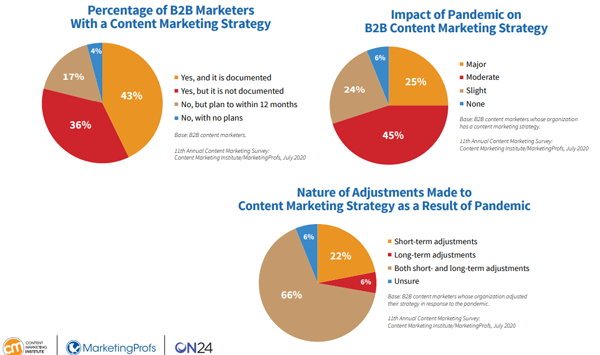
Slowly but surely, we’ve been making progress. Forty-three percent of respondents this year reported having a documented content strategy, which is a bit disappointing on its own, but encouraging when you looking at the running trend:
2020: 43%
2019: 41%
2018: 39%
2017: 37%
That’s remarkably steady and consistent growth! I might argue we’re still lagging behind on the whole, but progress is progress. Having said that, it is a bit ironic that at a time where more B2B marketers than ever have gotten their strategy down on paper, we’re being forced to crumple it up and rewrite it. [bctt tweet="“It’s a bit ironic that at a time where more B2B marketers than ever have gotten their strategy down on paper, we’re being forced to crumple it up and rewrite it.” — @NickNelsonMN @CMIContent #ContentMarketing" username="toprank"] Maybe that’s a bit strong, but 70% of respondents in the CMI survey said the pandemic has had a major or moderate impact on their B2B content strategy. Two-thirds indicated that the nature of their adjustments are both short-term and long-term. With this in mind, if you’re among the majority that still hasn’t developed a documented content strategy, this might be a good time to flesh one out that strikes this balance between the big and small pictures. During times of turbulence (and long-distance collaboration), it’s always good to have a single source of truth. Last year I provided a simple three-point checklist for documenting your content strategy, and the guiding principles still apply.
Adjustments to messaging and targeting are the top reactive priorities
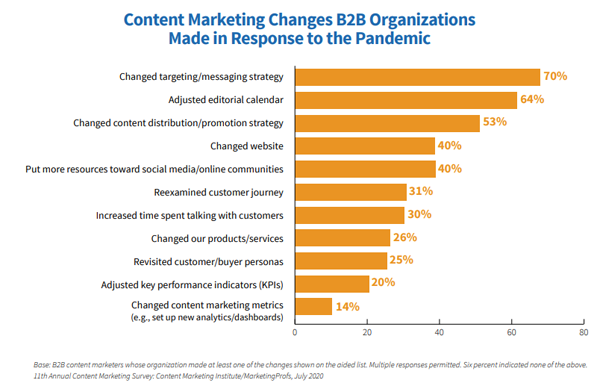
Asked about the specific changes their organizations have made in response to COVID-19, the top answer – selected by 70% of B2B marketers – was “Changed targeting/messaging strategy.” The most common answers after that were “Adjusted editorial calendar” and “Changed content distribution/promotion strategy.” Nothing too surprising about this. It goes without saying many marketing messages and campaigns that were conceived before the pandemic became irrelevant (if not blatantly tone-deaf) when the world was flipped on its side. Brands everywhere have been forced to fundamentally rethink what they’re saying, and who they’re saying it to. For that reason, I’m a little surprised that responses like “Reexamined customer journey,” “Increased time spent talking with customers,” and “Revisited customer/buyer personas” were all so low on the list. This does feel like a good time to get back in tune with the preferences and pain points that guide people toward our solutions.
Measurement methods have mostly remained stable
Another finding that stands out to me in the chart above is that “Adjusted key performance indicators” and “Changed content marketing metrics” were at the very bottom. For better or worse, it appears that most teams are sticking to the same yardsticks now as they were a year ago. Maybe that’s a good thing! If you’ve truly locked down your measurement strategy in a way that accurately proves out results and fosters constant refinement and optimization, it probably shouldn’t change based on outside circumstances. However, according to the 2020 Marketing Measurement & Attribution Survey from Demand Gen Report, 40% of marketers said their company’s current ability to measure and analyze marketing performance and impact “needs improvement,” while only 13% said they felt they were “excellent” in this regard. So perhaps reporting and analytics simply aren’t viewed as a priority at this time. I find that troubling, because in a time of widespread budget cuts and resource drains, the ability to demonstrate the revenue impact of marketing activities is arguably more important than ever.
Content creation challenges, not pandemic-related issues, are holding back success
Among those who rated their organization’s overall level of content marketing success in the past year as “Minimally Successful” or “Not at All Successful,” CMI broke down contributing factors in order to identify the most prevalent barriers. While the fairly broad “Pandemic-related issues” was available as an option, this was actually among the least common responses. At the top of the list, cited by 63% of laggards, was “Content creation challenges.” These challenges can take various forms (some of which can be doubly categorized as pandemic-related issues). “Our company needs more content. We serve a deep niche and few people understand our industry well enough to pop in and do small projects for us,” said one anonymous respondent quoted in the report. Said another: “Clients are getting bombarded with electronic information—especially now since in-person meetings and events are on hold. How do we create compelling content that gets distributed in a way that stands out from the clutter?”
Virtual events and live-streaming increased — but not THAT much
Among content types used by B2B marketers over the past 12 months, the biggest risers from last year are those you would expect:
Virtual events/webinars/online courses increased from 57% to 67%
Live-streaming increased from 10% to 29%
These are hefty jumps … but they still don’t point to ubiquity, by any means. There remains untapped opportunity on the frontier of online experiences, although clearly it’s getting crowded in a hurry. The second quote shared in the previous section points to this challenge, which is at the same time both new and old. Break through the clutter and earn attention: Amidst so much transformative change, this eternal edict of content marketers stays the same. We’re currently just seeing it play out in a new environment. [bctt tweet="“Break through the clutter and earn attention: Amidst transformative change, this eternal edict of content marketers stays the same.” — @NickNelsonMN @CMIContent #ContentMarketing" username="toprank"] Virtual events and live-streams have much potential for engagement and interactivity. We might receive some inspiration on these fronts when the folks behind this report bring their anticipated annual event, Content Marketing World, into the virtual realm this year for the first time. It’s going down on October 13-16, and our own Lee Odden will be delivering a presentation: Influencer Marketing Unleashed: Top Tactics for Success from Global B2B Brands. As Lee will illustrate, influencer marketing should be a piece of the puzzle in forward-looking B2B strategies. Many of the other trends outlined here will converge and shape the future of content marketing.
LinkedIn is launching interactive, Clubhouse-style audio events this month in beta; a video version will come this spring Microsoft's LinkedIn will launch a new live virtual events platform, beginning with audio-only functionality, followed in time by an array of video features for the flexible hosting and management of online events, adding to the platform's creator features, LinkedIn (client) recently announced. TechCrunch Social Media Forecast to Overtake TV in Ad Spend This Year A robust 14.8 percent annual growth rate for social media advertising spending over the 2021 through 2024 period tops online video’s 14 percent and paid search’s 9.8 percent, according to newly-released global ad spending growth rate forecast data. MarketingCharts 2022 Instagram Stories Benchmark Report Instagram Stories are being utilized more than ever by brands on the social media platform, according to recently-released report data of interest to digital marketers from Rival IQ, based on ...
With hybrid and remote work here to stay and digital-first marketing on the rise, how can B2B marketers make the most of these important shifts? Although I’ve written about remote work before, in pieces including “ Remote Communication Opportunities For B2B Marketers ,” “ Day 4,777: Remote Work Tips From 13+ Years As A Distance Marketer ,” and “ Hybrid & Remote Work Trends That Will Alter The Future Of B2B Marketing ,” the permanent changes to where and how we work have significant implications that will affect B2B marketers forever, so it’s time to reassess. Let’s take a close look at five ways B2B marketers can make the most from remote and hybrid work and digital-first brand interactions, from the perspective of someone who’s been working entirely remotely for 15 years, and from several top voices on the future of work. 1 — Adjust To The Permanent Shift In How We Work As I enter my thirty-eighth year working online, I’ve worked remotely for 5,409 days, and spent close to 40 p...
Is your agency a vendor or a partner? In response to the shifting market and evolving role of the CMO, agency-brand partnerships are shrinking in average duration, less than three years now, compared to over seven in 1984. But strategic, strong partnerships between brands and agencies have become increasingly important as 64% of CMOs expect to feel more pressure to demonstrate tangible short term results in the next 2-3 years. This pressure also signals a big opportunity for CMOs to demonstrate the value of marketing as a strategic function with organizations. The right agency, that can support the brand in a true partnership, can be critical in helping CMOs achieve their goals and win over the rest of the C-suite. That right agency, though, is tough to find — especially in the B2B space where market needs are shifting rapidly and new spaces and topics are constantly being created. How can you find an agency that isn’t just a vendor? How can you trust that you’ve chosen a true...
 With this in mind, if you’re among the majority that still hasn’t developed a documented content strategy, this might be a good time to flesh one out that strikes this balance between the big and small pictures. During times of turbulence (and long-distance collaboration), it’s always good to have a single source of truth. Last year I provided a simple three-point checklist for documenting your content strategy, and the guiding principles still apply.
 Nothing too surprising about this. It goes without saying many marketing messages and campaigns that were conceived before the pandemic became irrelevant (if not blatantly tone-deaf) when the world was flipped on its side. Brands everywhere have been forced to fundamentally rethink what they’re saying, and who they’re saying it to. For that reason, I’m a little surprised that responses like “Reexamined customer journey,” “Increased time spent talking with customers,” and “Revisited customer/buyer personas” were all so low on the list. This does feel like a good time to get back in tune with the preferences and pain points that guide people toward our solutions.


Comments
Post a Comment