Break Free B2B Marketing: Oliver Christie on Making Life Better With AI
Get link
Facebook
X
Pinterest
Email
Other Apps
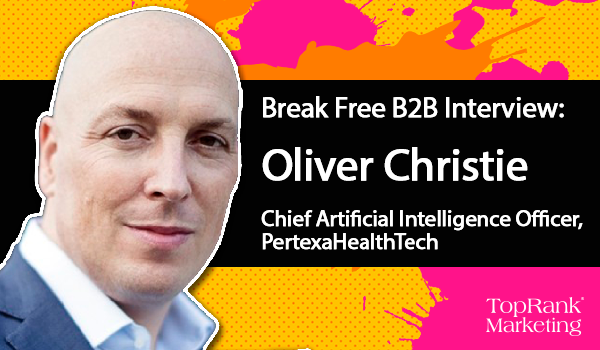
Just what is a B2B influencer, and what do they actually look like? In our third season of Break Free B2B Marketing video interviews we're having in-depth conversations with an impressive array of top B2B influencers, exploring the important issues that each expert is influential about. Successful B2B influencers have a rare mix of the 5 Ps — proficiency, personality, publishing, promotion, and popularity — as our CEO Lee Odden has carefully outlined in "5 Key Traits of the Best B2B Influencers." Offering up all of those boxes and more is Oliver Christie, chief artificial intelligence (AI) officer at PertexaHealthTech, who we're delighted to be profiling today. Nothing helps individuals and the businesses they work for break free from the norm quite like a tech disruption. The microprocessor. The internet. Mobile data. E-Commerce. When these technologies came onto the scene, everything changed… but what’s next? According to Oliver Christie, it’s AI. In his own words: "Artificial Intelligence is the biggest technology disruption of our generation." As far as he’s concerned, A.I. isn’t just the future, it’s the present. In today’s new episode of the Break Free B2B Marketing Interview series, Christie speaks about the role of artificial intelligence in our lives, including topics like A.I. and morality, bias in A.I., and the direction of A.I.’s future. Artificial intelligence isn't science fiction. It's very much a science reality, and Oliver Christie is one of the leading experts talking and consulting on the topic. In today's 31 minute interview with TopRank’s own Josh Nite, he'll be passing some of that expertise along.
Break Free B2B Interview with Oliver Christie
If you’re interested in checking out a particular portion of the discussion, you can find a quick general outline below, as well as a few excerpts that stood out to us.
:55 - Introduction to Oliver Christie
3:05 - Human-centric artificial intelligence
4:14 - Personalization and how to avoid the "diabolical side"
5:46 - The ways Oliver believes AI will impact the life of the everyday person in the next couple years
7:10 - Personalization on Amazon
11:13 - How AI will be reshaping business
13:46 - What's your new question?"
16:50 - How the pandemic is changing the way technology is being developed
19:10 - Bias in AI
22:46 - How Oliver Christie found his niche as a thought leader
27:58 - The importance of being yourself
Josh: I'm really interested in what we were talking about before we started. The idea of human-centric AI. AI can feel like this distant or cold thing or something that is, you know, it's powering my Netflix algorithm. But I don't know how it relates to my day to day. How is it a human-centric thing? We're thinking about people and individuals. Oliver: Something we're moving more and more towards is thinking about people as individuals and what matters to us. How we talk. How do we act? What are our interests? You mentioned Netflix. The algorithm which says what you should watch next. If that's successful, you watch more. If it has an understanding of what you might like, you can see more media if you get it. If it gets it wrong, if it doesn't know who you are, it is a turnoff and you never see the difference between that and other media services. I think that the next big leap is going to be our products and services are going to be much more reactive to who we are. How will we live? And so on. But there are some big challenges. So it's not a quick and easy thing to do. But I think the future is pretty exciting. [bctt tweet="“I think that the next big leap is going to be our products and services are going to be much more reactive to who we are.” @OliverChristie #BreakFreeB2B #ArtificialIntelligence #AI" username="toprank"] Josh: Have you ever been on Amazon while not logged in? It's such a striking thing to open an incognito window or something and you see how much personalization goes into that page and how just clueless it seems when it's not on there. Oliver: Amazon’s an interesting one. It's algorithm is better than nothing. And it works to a degree. Some of the time, if you match a pattern — so the music you listen to, the books you buy — f someone is quite close to that, it works. As soon as you deviate, it pulls down or as soon as you're looking for something original, it also doesn't work. So I think Amazon is a good example of where we are at the moment, but not where we could be next. Amazon doesn't once ask, what are you trying to achieve in your shopping? What are you trying to do next? And I think that's going to be one of the big shifts that will happen. Josh: What are we trying to achieve with that shopping, though? Besides, for me, it's filling the void of not being able to go out to a concert and having a party, having something to look forward to with deliveries coming in. What kind of intent are you thinking about? Oliver: Imagine you had the same shopping experience and let's say it's for books, videos, or courses. And the simple question can be, what would you like to achieve in your career in the next six months? Where would you like to be or what's happening in your personal life? Want some advice and information which could be really useful? I think this sort of tailoring is where things are heading. So it's still selling books and courses and videos and so on. But it's understandably the intent behind content. What could this do to your career? What could this do for your family life, your love life, whatever it might be? Now, of course, we're all locked down at the moment. So it's a very different sort of situation. But I think some of the same things still apply. There's going to be a back and forth. So how much do you want to give up about your personal life? Better recommendation. And I think it's kind of early in some respects. But the data they passed shows, yes, if you get something positive out of it, you'll have to give up some of that previously. [bctt tweet="“Amazon is a good example of where we are at the moment, but not where we could be next. Amazon doesn't once ask, what are you trying to achieve in your shopping? What are you trying to do next?.” @OliverChristie #BreakFreeB2B" username="toprank"] Keep your eye on the TopRank Marketing Blog and subscribe to ourYouTube channelfor more Break Free B2B interviews.Also check out episodes from season 1 and season 2. Take your B2B marketing to new heights by checking out out previous season 3 episodes of Break Free B2B Marketing:
LinkedIn is launching interactive, Clubhouse-style audio events this month in beta; a video version will come this spring Microsoft's LinkedIn will launch a new live virtual events platform, beginning with audio-only functionality, followed in time by an array of video features for the flexible hosting and management of online events, adding to the platform's creator features, LinkedIn (client) recently announced. TechCrunch Social Media Forecast to Overtake TV in Ad Spend This Year A robust 14.8 percent annual growth rate for social media advertising spending over the 2021 through 2024 period tops online video’s 14 percent and paid search’s 9.8 percent, according to newly-released global ad spending growth rate forecast data. MarketingCharts 2022 Instagram Stories Benchmark Report Instagram Stories are being utilized more than ever by brands on the social media platform, according to recently-released report data of interest to digital marketers from Rival IQ, based on ...
With hybrid and remote work here to stay and digital-first marketing on the rise, how can B2B marketers make the most of these important shifts? Although I’ve written about remote work before, in pieces including “ Remote Communication Opportunities For B2B Marketers ,” “ Day 4,777: Remote Work Tips From 13+ Years As A Distance Marketer ,” and “ Hybrid & Remote Work Trends That Will Alter The Future Of B2B Marketing ,” the permanent changes to where and how we work have significant implications that will affect B2B marketers forever, so it’s time to reassess. Let’s take a close look at five ways B2B marketers can make the most from remote and hybrid work and digital-first brand interactions, from the perspective of someone who’s been working entirely remotely for 15 years, and from several top voices on the future of work. 1 — Adjust To The Permanent Shift In How We Work As I enter my thirty-eighth year working online, I’ve worked remotely for 5,409 days, and spent close to 40 p...
Is your agency a vendor or a partner? In response to the shifting market and evolving role of the CMO, agency-brand partnerships are shrinking in average duration, less than three years now, compared to over seven in 1984. But strategic, strong partnerships between brands and agencies have become increasingly important as 64% of CMOs expect to feel more pressure to demonstrate tangible short term results in the next 2-3 years. This pressure also signals a big opportunity for CMOs to demonstrate the value of marketing as a strategic function with organizations. The right agency, that can support the brand in a true partnership, can be critical in helping CMOs achieve their goals and win over the rest of the C-suite. That right agency, though, is tough to find — especially in the B2B space where market needs are shifting rapidly and new spaces and topics are constantly being created. How can you find an agency that isn’t just a vendor? How can you trust that you’ve chosen a true...


Comments
Post a Comment