Break Free B2B Marketing: Liam McIvor Martin of Time Doctor on The Revolutionary Power of Remote Work
Get link
Facebook
X
Pinterest
Email
Other Apps
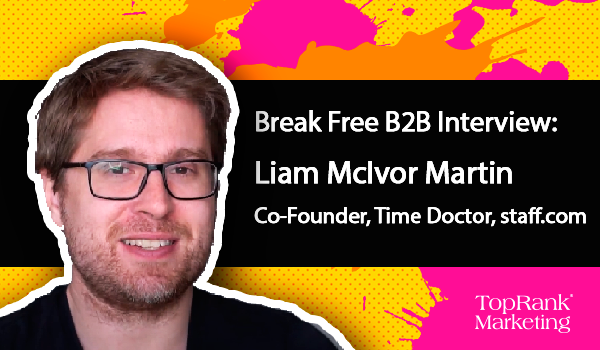
When it comes to B2B influencer marketing, it's only natural to wonder what an influencer actually looks like? In our third season of Break Free B2B Marketing video interviews we’re continuing in-depth conversations with a powerful selection of top B2B influencers, and exploring the issues that each expert is influential about. All successful B2B influencers have a rare mix of the 5 Ps — proficiency, personality, publishing, promotion, and popularity — as our CEO Lee Odden has outlined in “5 Key Traits of the Best B2B Influencers.” Incorporating all of these qualities and more is Liam McIvor Martin, co-founder of Time Doctor, who we’re thrilled to be profiling today. 2020 was a year of immense change that has continued into 2021. One change that’s been especially significant for B2B marketers is the rise of remote work. Remote work has always been around, but 2020 saw it change from option to necessity. Businesses large and small have had to send their employees home to quarantine and stay safe in the wake of the Covid-19 pandemic. Many of these decisions had to be made quickly. Whenever a process is rushed, there’s an increased chance of things going wrong. That’s why businesses are wondering where those pitfalls lie, how they can avoid them, and beyond. That’s why we asked Liam McIvor Martin to appear on Season 3 of the Break Free B2B Marketing interview series. Liam has been answering questions about remote work for years - and he doesn’t plan on stopping anytime soon. He has the credentials to prove it: he’s the co-founder of TimeDoctor, a leader in time tracking software, and the co-organizer of Running Remote, the world's largest conference on building and scaling remote teams. In today’s 37 minute interview with TopRank’s Nick Nelson he'll be sharing the expertise he’s gained over his years promoting remote work.
Break Free B2B Interview with Liam McIvor Martin
If you’re interested in checking out a particular portion of the discussion, you can find a quick general outline below, as well as a few excerpts that stood out to us.
1:30 - Introduction to Liam McIvor Martin
4:45 - Trends in remote work
7:05 - Definable advantages of remote work for businesses
10:48 - How to keep your team tight knit while working hybrid or remote
16:55 - Examples of companies making transformational shifts and overcoming remote work related challenges
20:27 - Things preventing businesses from finding success with remote work
26:25 - Recommendations for solutions or products that can benefit companies looking to find as much success as possible with remote work
29:26 - How Liam developed his personal brand
33:30 - Where to find Liam and how to get in touch
Nick: I think we can all look at the trends and see that the remote work and work flexibility were very much on the rise before 2020 and all of its events. Can you talk a little bit about the sort of the trends you were seeing leading up to this, and the impact that you've seen from the pandemic and its effects? Liam: Sure. So, in 2018, 5.5% of the U.S. workforce was working full time remotely. The OECD and U.S. Census defines that as more than four days a week working outside of the office. So that's a really important qualifier there because remote-first companies, which is what we are, were in 37 different countries all over the world. We don't have any offices. We work entirely remote. But post-COVID, it's at 58% — which is nuts. So we went from 5.5% to 58%. And we were projected to actually be at 50% by 2027. We literally just jumped five years into the future. We've seen Twitter go remote, we see Google saying they're going to stay remote by 2022. Facebook is going 50% remote, Shopify — all of these companies are going remote now and we're really starting to see a tide change. Recognizing that remote is not only a better economic decision for employers, but it's also a much better decision for the employee. So there's a really interesting push pull, and my estimate is that after COVID is over — and I mean vaccine-over — we're probably going to float to around 50% of the U.S. workforce working remotely. You're sitting in an empty office right now. I think there's gonna be a lot more of those in the next couple years. [bctt tweet="“My estimate is that after COVID is over, and I mean vaccine-over, we're probably going to float to around 50% of the US workforce working remotely.” — Liam McIvor Martin @vtamethodman #BreakFreeB2B #remotework" username="toprank"] Nick: Yes, the impacts across the board are going to be really interesting. You talked a little bit about how the benefits are being seen on the business side. For instance, not having to pay for a physical office space is huge for a business. I think a lot of companies and people are really starting to see these benefits. What would you say are these advantages that are coming out that people are starting to see? Any surprising ones? Liam: Sure. The biggest problem that people had with going remote, which was actually the biggest problem, and still is the biggest problem that Time Doctor addresses is, well, how do I know what those people are doing if I can't see them. That's what Time Doctor fundamentally solves. And then there's a whole bunch of other tools that are out there that can also solve other aspects of remote work as well. But, fundamentally, a whole bunch of people tried this en masse. And they realized that within the first month, two months, three months — man — the numbers are coming back. And they're as productive, if not more productive than when they were in the office. And that's actually quite counterintuitive. And it's quite interesting. When we look at the research — and there's very little research that's been done — but a lot more research that's currently being done. There are more distractions at home — there's kids, there's your dog, there's PlayStation, there's, you know, CNN — there's all of these different distractions that occur. However, if you remove the commute, which on average is about two and a half hours per day, for every working person — if you literally just deployed that as sleep, you're going to get a much more productive person. So it's not necessarily that remote work is more productive, it's that you're actually removing a major chunk of your day, which is sitting in a car back and forth, or sitting on a bus or a train or something like that back and forth, to be able to earn that time back. On the employer side, employers are recognizing at this point that it's just as productive. People are pretty happy. We just did a poll at the Running Remote online event that asked every one of those who were recently remote, how many of you are canceling your office leases, and 22% said that they're canceling their office leases. And when you think about that, a lot of them are saying, "Well, we're cancelling our office lease, but we still have a year and a half left, or we still have two years left on that office lease." So that actually is a really interesting trigger inside of the economy that hasn't been fully recognized yet. Because everyone's still getting paid. But within the next eight to 24 months, I think you're going to see an entire collapse of the office kind of rental space — the commercial lease space. So there's a bunch of things that are going on, and we really don't know what the future is going to hold, but I know for sure that remote is definitely going to be a bigger piece of the pie. [bctt tweet="“Fundamentally, a whole bunch of people tried this en masse and realized that within the first months, man, the numbers are coming back, and they're as productive, if not more productive than when they were in the office.” @vtamethodman" username="toprank"] Keep your eye on the TopRank Marketing Blog and subscribe to ourYouTube channelfor more Break Free B2B interviews.Also check out episodes from season 1 and season 2. Take your B2B marketing to new heights by checking out out previous season 3 episodes of Break Free B2B Marketing:
LinkedIn is launching interactive, Clubhouse-style audio events this month in beta; a video version will come this spring Microsoft's LinkedIn will launch a new live virtual events platform, beginning with audio-only functionality, followed in time by an array of video features for the flexible hosting and management of online events, adding to the platform's creator features, LinkedIn (client) recently announced. TechCrunch Social Media Forecast to Overtake TV in Ad Spend This Year A robust 14.8 percent annual growth rate for social media advertising spending over the 2021 through 2024 period tops online video’s 14 percent and paid search’s 9.8 percent, according to newly-released global ad spending growth rate forecast data. MarketingCharts 2022 Instagram Stories Benchmark Report Instagram Stories are being utilized more than ever by brands on the social media platform, according to recently-released report data of interest to digital marketers from Rival IQ, based on ...
With hybrid and remote work here to stay and digital-first marketing on the rise, how can B2B marketers make the most of these important shifts? Although I’ve written about remote work before, in pieces including “ Remote Communication Opportunities For B2B Marketers ,” “ Day 4,777: Remote Work Tips From 13+ Years As A Distance Marketer ,” and “ Hybrid & Remote Work Trends That Will Alter The Future Of B2B Marketing ,” the permanent changes to where and how we work have significant implications that will affect B2B marketers forever, so it’s time to reassess. Let’s take a close look at five ways B2B marketers can make the most from remote and hybrid work and digital-first brand interactions, from the perspective of someone who’s been working entirely remotely for 15 years, and from several top voices on the future of work. 1 — Adjust To The Permanent Shift In How We Work As I enter my thirty-eighth year working online, I’ve worked remotely for 5,409 days, and spent close to 40 p...
Is your agency a vendor or a partner? In response to the shifting market and evolving role of the CMO, agency-brand partnerships are shrinking in average duration, less than three years now, compared to over seven in 1984. But strategic, strong partnerships between brands and agencies have become increasingly important as 64% of CMOs expect to feel more pressure to demonstrate tangible short term results in the next 2-3 years. This pressure also signals a big opportunity for CMOs to demonstrate the value of marketing as a strategic function with organizations. The right agency, that can support the brand in a true partnership, can be critical in helping CMOs achieve their goals and win over the rest of the C-suite. That right agency, though, is tough to find — especially in the B2B space where market needs are shifting rapidly and new spaces and topics are constantly being created. How can you find an agency that isn’t just a vendor? How can you trust that you’ve chosen a true...


Comments
Post a Comment